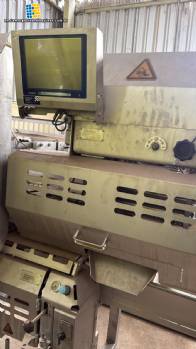
Technical Overview: Poultry Breast Filleting Systems
Breast filleting (or deboning) is the highest value-added stage in a poultry processing plant.
The goal is to convert the "front halves" (bone-in breast) into fillets and inner fillets (tenders/sassami) with maximum precision, preventing noble protein from being discarded as residue (MDM - Mechanically Deboned Meat).
Types of Machines and Categories There are three main categories of equipment, divided by level of automation and complexity:
A. Cone Lines (Manual or Semi-Automatic Systems)
Operating Principle: It consists of a conveyor chain equipped with steel or polymer "cones".
Operators manually shackle the front halves onto the cones, and the carcass passes through workstations where workers perform cuts using manual or pneumatic knives.
Production: Depends on the number of operators.
A standard line can process from 500 to 1,200 pieces / hour per line.
Key Factor: High flexibility for different chicken sizes, but extremely high labor costs and a higher risk of accidents.
B. Modular Automatic Filleting Systems (e.g., Marel AMF)
Operating Principle: The machine utilizes a transport rail where the carcass is fixed onto a carrier.
The main advantage here is modularity. The carcass passes through mechanical "stations": one module removes the skin, another cuts the wishbone (fúrcula), another harvests the fillet, and the last one removes the inner fillet (sassami).
Production: Between 3,000 and 6,500 carcasses / hour.
Key Factor: It is the most robust system on the market.
Models such as the AMF-i use sensors to measure the bone structure and adjust blade pressure automatically, ensuring the "Yield" even in non-uniform flocks.
C. Integrated High-Speed Filleting Systems (e.g., Meyn Rapid)
Operating Principle: Unlike cone systems or horizontal rails, these machines are usually more compact and use a carousel or rapid indexing system.
They are designed for "automatic harvesting": the carcass enters, and the parts exit separated on different belts at extremely high speeds.
Production: Can reach 7,000 to 8,000 carcasses / hour.
Key Factor: Smaller footprint in the factory, but requires much more rigorous electronic and technical maintenance.
Yield and Efficiency
Yield is measured by the amount of meat harvested relative to the total weight of the carcass.
Meat Loss on Bone: In poorly trained manual systems, up to 3% of noble meat is lost.
In systems like the AMF-i, this loss drops to levels below 0.5%.
Inner Fillet (Sassami) Integrity: The major technical challenge is removing the inner fillet without breaking it.
Modern automatic machines use scrapers that "mimic" the human thumb movement, ensuring the visual quality required for the export market. |