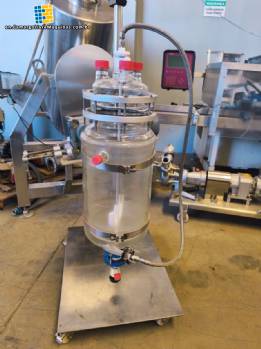
BOROSILICATE GLASS REACTORS AND PROCESS VESSELS
1. OPERATING PRINCIPLE AND MANUFACTURING PROCESS
Operating Principle:
Reagent injection via top neck nozzles on the sanitary sealing lid.
Mixing driven by a central PTFE agitation shaft with zero metal contact.
Thermal control via closed-loop fluid circulation (chilled water, steam, or thermal oil).
Total transparency for visual monitoring of phase transitions, precipitation, and color changes.
Manufacturing Process:
Melting & Molding: High-purity borosilicate glass tubing heated in precision lathes above 1,200°C. Nozzles, necks, and ports hot-fused directly into the vessel body.
Flange Lap-Grinding: Mechanical precision grinding of sealing surfaces to ensure vacuum-tight integrity under high vacuum.
Annealing: Stress-relieving thermal cycle in a tunnel kiln at approx. 560°C with controlled, slow cooling to eliminate 100% of residual mechanical stress.
2. GLASS TYPES AND TECHNOLOGICAL COMBINATIONS
3.3 Borosilicate Glass (ISO 3585 Standard):
Composition: 81% SiO2, 13% B2O3, 4% Na2O/K2O, 2% Al2O3.
Ultra-low linear thermal expansion coefficient (3.3 x 10^-6 / K).
Total immunity to corrosion from acids and halogenated compounds.
Poly-Coated / Plastic-Coated Borosilicate Glass:
External transparent polymer or silicone coating (0.2 mm to 0.5 mm).
Anti-shatter protection for operator safety.
Hazardous fluid containment in case of accidental mechanical breakage.
Amber / Actinic Glass:
Protective coating or glass tint blocking light radiation in the 300 nm to 500 nm range.
Engineered for synthesis of light-sensitive and UV-sensitive compounds.
Quartz Glass (Fused Silica > 99.9% SiO2):
Withstands continuous operating temperatures above 300°C and extreme thermal shock.
High UV transmittance for photochemical reactions.
Glass-Lined Steel:
Sintered vitrified enamel coating (1.0 mm to 2.2 mm) fused onto carbon or stainless steel.
Designed for large-scale industrial reactors (500L to 20,000L) where pure glass lacks structural pressure capacity.
3. SPECIFICATIONS BY WALL TYPE, THICKNESS, PRESSURE, AND TEMPERATURE
Single-Wall (Unjacketed):
Wall thickness: 5 mm to 12 mm
Temperature range: -80°C to +200°C
Max thermal shock: delta T up to 110°C
Pressure range: Full vacuum (-1 bar) up to +0.5 bar
Application: Mixing, dissolution, and ambient temperature reactions without active thermal control
Jacketed (Double-Wall):
Inner vessel wall thickness: 6 mm to 12 mm
Outer jacket wall thickness: 4 mm to 8 mm
Temperature range: -80°C to +200°C
Inner vessel pressure: Full vacuum (-1 bar) up to +0.5 bar
Thermal jacket pressure: Up to +0.5 bar
Application: Endothermic or exothermic processes requiring precise thermal control
Triple-Wall (Vacuum Jacketed):
Inner vessel wall thickness: 6 mm
Thermal jacket wall thickness: 4 mm
Outer vacuum jacket thickness: 4 mm
Temperature range: -100°C to +200°C
Pressure: Full vacuum in inner vessel; permanently sealed vacuum chamber in outer wall
Application: Cryogenic reactions with thermal insulation and no exterior frosting/icing
4. STANDARD VOLUMETRIC CAPACITIES
Laboratory & Benchtop Scale:
250 mL
500 mL
1 Liter
2 Liters
5 Liters
10 Liters
Pilot Scale:
15 Liters
20 Liters
30 Liters
50 Liters
Semi-Industrial Scale:
100 Liters
150 Liters
200 Liters (Safe structural limit for self-supporting glass vessels)
5. CHEMICAL COMPATIBILITY: 3.3 BOROSILICATE GLASS VS. STAINLESS STEEL (316L)
Products Safe in Glass that Severely Corrode 316L Stainless Steel:
Hydrochloric Acid (HCl): Causes severe pitting corrosion and stress corrosion cracking in stainless steel. Inert in glass.
Aqua Regia (HCl + HNO3 mixture): Dissolves most metal alloys. Inert in glass.
Halogenated Acids (HBr and HI): Highly aggressive halogens safely handled in glass.
Inorganic Chlorides in Acidic Media (FeCl3, AlCl3, ZnCl2): Destroy the protective passive layer of stainless steel.
Organic Chlorides & Acetyl Chloride: Release free chloride ions and hydrochloric acid during synthesis.
Hot Concentrated Sulfuric Acid (H2SO4): Causes rapid wall thickness loss in metal tanks.
Hot Formic Acid & Glacial Acetic Acid: Corrode and degrade 316L stainless steel at elevated temperatures.
Prohibited or Restricted Substances in 3.3 Borosilicate Glass:
Hydrofluoric Acid (HF): Strictly prohibited. Reacts directly with silicon dioxide (SiO2), dissolving the glass.
Hot Concentrated Strong Bases (NaOH & KOH > 10% above 60°C): Cause alkaline etching of silica, leading to clouding and structural weakening.
Hot Concentrated Phosphoric Acid (H3PO4 > 85% above 100°C): Gradually etches the vitrified surface.
Acid Fluorides (NH4HF2): Release free fluoride ions that attack the silicon matrix.
6. MIXER TYPES, IMPELLERS, AND MATERIALS
In glass reactors, the agitation shaft is engineered from stainless steel encapsulated in heavy-wall PTFE (Teflon) or solid PTFE, preventing any product contact with metallic surfaces.
Anchor Impeller:
Low-speed operation (20 to 150 RPM).
Sweeps inner wall with tight clearance (3 mm to 5 mm).
Designed for medium to high viscosity fluids (1,000 to 50,000 cP), ensuring uniform heat transfer.
Pitch Blade / Flat Paddle Impeller:
Moderate speed operation (100 to 400 RPM).
Generates combined axial and radial flow.
Ideal for general mixing, blending, and solid-liquid dissolution.
Propeller Impeller:
High-speed operation (300 to 1,200 RPM).
Generates strong axial flow with high pumping efficiency.
Suited for low-viscosity fluids and rapid reagent dispersion.
Rushton Turbine (Flat Blade):
High-speed operation with intense radial shear.
Ideal for gas-liquid dispersion (sparging) and emulsification.
Collapsible PTFE Impeller:
Articulated PTFE blades that fold parallel to the shaft to pass through narrow necks (GL-45 or tapered joints).
Open automatically via centrifugal force during rotation inside the vessel.
7. GLOBAL MANUFACTURER MAPPING
Premium International Manufacturers:
De Dietrich Process Systems / QVF (Germany/France): Global leader in industrial glass plants and large-scale reactors.
Buchi AG / Buchiglasuster (Switzerland): High-precision pilot glass reactors with leak-free magnetic couplings.
Asahi Glassplant Inc. - AGI (Japan): Leader in high-performance jacketed and triple-wall glass reactors.
Heidolph Instruments (Germany): Laboratory and pilot-scale synthesis reactors and evaporators.
Commercial Line International Manufacturers:
Zhengzhou Greatwall / ZZKD / Lanphan (China): Standardized single-wall and jacketed glass reactors focused on cost-efficiency.
Brazilian System Integrators & Manufacturers:
Agiglass / Vidrolabor: Custom 3.3 borosilicate glass blowing and fabrication.
Ionlab / Tecnal / Splabor: Integration of glass reactor systems with stainless steel frames and drives.
8. INDUSTRIAL SECTORS, LABORATORIES, AND APPLICATIONS
Target Industrial Sectors:
API & Pharmachem (Active Pharmaceutical Ingredients): cGMP-compliant synthesis under ANVISA/FDA validation.
Fine & Specialty Chemicals: High-purity reagent and catalyst production with zero metal contamination.
High-Performance Cosmetics: Active ingredient and dermocosmetic serum processing.
Botanical & Cannabinoid Extraction: Winterization, decarboxylation, and extract purification.
Laboratory Types:
R&D Laboratories: Process development and scale-up from benchtop to pilot scale.
Advanced Organic Synthesis Labs: Handling corrosive chemistry, bromination, nitration, and chlorination.
Kilo-Labs: Small-batch, high-value API and specialty chemical production. |