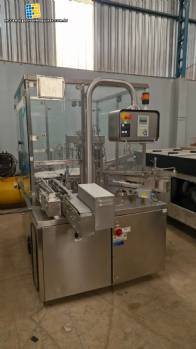
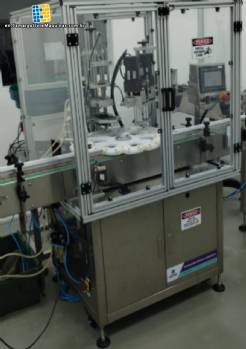
Rotary Monoblock Filling and Capping Machine: Operation, Technologies, Industrial Applications, and Technical Guide
1. What Is a Rotary Monoblock Filling and Capping Machine?
A rotary monoblock filling and capping machine is an automated industrial packaging system designed to integrate two or more primary packaging operations into a single mechanical structure. Depending on its configuration, the machine can perform bottle feeding, internal container cleaning, liquid filling, plug and dropper insertion, valve placement, cap positioning, screw capping, inspection, and automatic rejection of nonconforming containers.
Also known as an automatic rotary filling machine, monoblock liquid filler and capper, or integrated filling and closing machine, this equipment is used in the pharmaceutical, cosmetics, veterinary, food, nutraceutical, and chemical industries.
Its operating principle relies on the sequential and synchronized execution of packaging operations through mechanical, pneumatic, electrical, and electronic systems. Container movement may be intermittent, with stops at working stations, or continuous, with bottles moving during selected operations.
The main benefits of an automatic monoblock packaging machine include process integration, reduced floor space, standardized production parameters, and the ability to incorporate inspection, process control, and traceability systems.
2. Operating Principles and Container Transport Systems
Containers may be transported by rotary star wheels, indexing tables, grippers, synchronized conveyors, or individual carriers known as pucks. The appropriate solution depends on bottle geometry, dimensions, stability, and packaging material.
Rotary star wheels are often manufactured from engineering polymers such as UHMW-PE and POM. Material selection depends on wear resistance, dimensional stability, chemical compatibility, and cleaning requirements.
The drive system may include gear reducers, mechanical indexing units, servo motors, or a combination of technologies. Servo-driven machines can synchronize stations through electronic motion control, including electronic cam profiles.
The monoblock architecture coordinates filling and closing operations within an integrated system. This can reduce intermediate transfers, simplify process control, and lower the risk of bottle tipping or misalignment when the transport system is properly designed.
Use in cleanrooms or aseptic manufacturing environments requires additional measures involving hygienic design, environmental control, containment, cleaning, and validation. A monoblock configuration alone does not guarantee sterility or cleanroom compliance.
3. Types of Rotary Monoblock Filling Machines
3.1. Intermittent-Motion Monoblock Machines
An intermittent-motion rotary filling machine advances its indexing table or star wheel between defined positions and stops for part of the operating cycle. Filling, component insertion, and capping operations may take place during these stops.
This architecture is suitable for a range of production requirements and can facilitate operations that require stable container positioning, including volumetric filling, plug insertion, and screw capping.
Output depends on the number of filling heads, dosing time, product characteristics, number of stations, and movement time. There is no universal production-speed range that applies to every intermittent-motion monoblock machine.
3.2. Continuous-Motion Monoblock Machines
In a continuous-motion rotary filling machine, containers remain in motion while operations are performed. Filling nozzles and capping heads may follow the containers through synchronized tracking mechanisms or moving assemblies.
This architecture is commonly used for higher-output applications. Continuous motion can reduce the effects of acceleration and deceleration on the liquid, but it does not automatically eliminate splashing, foaming, or turbulence.
Performance depends on viscosity, flow rate, surface tension, nozzle design, bottle geometry, and filling process control.
3.3. Single-Turret Rotary Systems
In a single-turret configuration, operating stations are arranged around a main rotary table or star wheel. This arrangement can provide a compact machine when the number of operations and required cycle times are compatible with the design.
3.4. Multi-Star Transfer Systems
Multi-star systems use successive transfer wheels to move bottles between operations. Depending on the configuration, separate stars may handle filling, component insertion, cap placement, closing, and discharge.
The number of transfer wheels and the allocation of operations depend on the machine design. Transfers must account for container stability, synchronization, and positioning accuracy.
3.5. Puck-Based Container Handling
Pucks are individual carriers that hold bottles during transport and packaging operations. They can be useful for narrow-base containers, asymmetric bottles, unstable packaging, and shapes that are difficult to handle directly.
The need for puck-based transport should be determined through testing of container stability, production speed, positioning accuracy, and format compatibility.
4. Main Stations of an Automatic Filling and Capping Machine
4.1. Bottle Feeding, Transfer, and Internal Cleaning
Containers enter through an infeed conveyor and are separated by timing screws, guides, synchronization devices, or other feeding mechanisms. They are then transferred to the machine's star wheels or positioning units.
When required, internal container cleaning may use filtered-air blowing, particle extraction, ionization, or a combination of methods.
Process-air specifications should address particulate contamination, moisture, oil, and microbiological quality according to the intended application. HEPA filters and compressed-air treatment filters have different functions and qualification criteria.
Ionization can reduce electrostatic charge on certain plastic containers and support particle removal. However, it does not replace cleaning and does not guarantee sterilization.
4.2. Liquid Filling and Dosing
The filling system positions the nozzles relative to the bottle neck and target fill level. Depending on the machine, nozzles may remain stationary or move vertically during filling.
For products prone to foaming or splashing, bottom-up filling may be used. In this process, the nozzle follows the rising liquid level to control the falling stream and reduce turbulence.
The method must be selected according to the product and container because not all formulations require bottom-up filling.
Residual dripping can be controlled through nozzle-tip shutoff valves, anti-drip devices, or suck-back systems. Selection depends on viscosity, stringing behavior, volatility, and chemical compatibility.
4.3. Plug, Dropper, and Valve Insertion
The insertion station places internal components or dispensing systems into the bottle neck. Typical components include internal dropper inserts, flow restrictors, spray valves, and dispensing pumps.
Components may be supplied by vibratory feeders, centrifugal feeders, chutes, or dedicated automatic feeding systems. Transfer mechanisms can include grippers, mechanical insertion heads, and industrial robots.
For pumps with dip tubes, the tube length must match the bottle height and geometry. Guides and centering devices can reduce the risk of tube bending or incorrect positioning when properly designed.
The feeding technology must be suitable for the component geometry and fragility.
4.4. Cap Positioning and Placement
Caps are oriented and delivered to the capping station through chutes, feeders, grippers, vacuum systems, or dedicated mechanisms.
For screw caps, initial alignment between the cap and bottle neck is essential to reduce cross-threading, mechanical damage, and improper closure.
The cap presentation method must account for cap geometry, material, machine speed, and closure requirements.
4.5. Screw Capping and Torque Control
Capping systems may use mechanical clutches, torque limiters, magnetic couplings, or servo-driven heads.
Torque-limiting heads help control tightening force and reduce the risk of over-tightening. Servo-driven systems can control parameters such as rotational speed, angular position, and torque limits, depending on the installed instrumentation.
Commanded or estimated torque must be distinguished from directly measured torque. Recording individual torque values for every container requires dedicated measurement, data acquisition, and traceability capabilities.
Closing parameters should be established through appropriate testing of seal integrity, leakage performance, opening force, and compatibility between the bottle, cap, and product. Common torque units include N·cm, N·m, and lbf·in.
4.6. Quality Inspection and Automatic Rejection
Inspection systems may include photoelectric sensors, height sensors, measurement devices, industrial cameras, and machine vision systems.
Depending on the configuration, the machine can inspect cap presence, closure height, plug presence, component alignment, and other visible characteristics.
Torque verification requires an appropriate measurement system because a conventional camera cannot directly confirm the applied torque.
Rejected containers may be diverted using pneumatic ejectors, mechanical mechanisms, or robotic systems. The rejection process should be validated to prevent nonconforming containers from re-entering the accepted product flow.
Uninterrupted operation during rejection depends on the control system, safety requirements, and the machine's ability to manage faults.
5. Liquid Filling Technologies for Industrial Packaging Machines
Filling technology should be selected according to the required volume, viscosity, chemical composition, product sensitivity, dosing accuracy, and cleaning procedures.
5.1. Peristaltic Pump Filling
A peristaltic pump uses rollers or compression elements to act on flexible tubing, moving liquid through progressive tube deformation.
The product primarily contacts the inside of the tubing and other components in the product pathway. When designed for this purpose, the system can use dedicated or disposable tubing assemblies to facilitate product changeovers and reduce cross-contamination risks.
Tubing life, chemical compatibility, and resistance to cleaning or sterilization cycles must be evaluated. Wear can affect dosing accuracy.
Applications include pharmaceutical solutions, diagnostic reagents, liquid cosmetics, and specifically designed and validated aseptic processes. A peristaltic pump alone does not guarantee sterility or zero cross-contamination.
5.2. Volumetric Piston Filling
A volumetric piston filler uses a cylinder and piston to draw in and dispense a defined quantity of liquid. Flow direction may be controlled by valves or switching mechanisms.
This technology can provide mechanical robustness, repeatability, and the ability to handle different viscosities when properly sized and adjusted.
Performance depends on seals, wear, suspended particles, product properties, and operating parameters.
Typical applications include syrups, gels, lotions, fluid creams, and other compatible formulations. AISI 316L stainless steel may be specified for selected product-contact parts, subject to compatibility assessment of seals and other materials.
5.3. Valve-Free Ceramic Piston Filling
In certain microdosing systems, a ceramic element combines translational and rotational movement to switch between suction and discharge channels without conventional independent valves.
This technology can offer good repeatability, wear resistance, and suitability for applications requiring small filling volumes.
Accuracy depends on operating clearances, wear, liquid properties, and manufacturing quality. CIP, or Cleaning in Place, and SIP, or Sterilization in Place, compatibility must be confirmed for the specific model.
Applications include pharmaceutical microdosing and high-value products compatible with the system.
5.4. Coriolis Mass Flow Meter Filling
A Coriolis meter uses vibrating tubes to determine the mass flow rate of a fluid. Depending on the model, it may also measure density and temperature.
Mass-based dosing can reduce dependence on conventional piston mechanisms. Dispensed quantities can be controlled through software when appropriate valves, instrumentation, and control systems are installed.
Performance depends on flow range, product properties, installation, and system response time.
Potential applications include chemicals, cosmetics, oils, and other compatible formulations.
5.5. Gravimetric Filling
Gravimetric filling uses load cells to determine product mass. The system may weigh the container during filling or use other weighing strategies before and after dispensing.
Its main advantage is direct mass measurement. Control algorithms can correct dosing deviations when the measurement equipment and control strategy are suitable.
Vibration, air currents, mechanical stability, and settling time can affect accuracy.
Gravimetric filling may be appropriate for diagnostic reagents, chemicals, high-value products, and applications where mass-based dosing is preferred.
6. Bottles, Caps, and Dispensing Systems
Container and closure selection must account for formulation compatibility, light protection, product stability, seal integrity, and commercial presentation.
Amber glass bottles are used for light-sensitive products. Glass type selection depends on chemical resistance and applicable formulation requirements. Amber PET bottles may also provide light protection, depending on material composition and optical properties, but they are not equivalent to pharmaceutical Type I, II, or III glass.
Dropper bottles may use different neck finishes and dispensing inserts. Dimensional compatibility between the bottle, insert, and cap must be confirmed.
Syrup bottles generally have larger capacities and may use screw caps, child-resistant closures, or measuring-cup assemblies.
Serum and dermocosmetic bottles may be made of glass or plastic and equipped with droppers, dispensing pumps, or spray valves.
Pharmaceutical vials may use elastomeric stoppers and aluminum seals, including flip-off closures, according to the specified container-closure system.
Flexible plastic bottles may be manufactured from LDPE, HDPE, or other compatible polymers. Their flexibility depends on material grade, wall thickness, and container design.
Commercial sizes such as 5 mL, 10 mL, 15 mL, 20 mL, 30 mL, 50 mL, 100 mL, and 150 mL are examples rather than universal limits for all filling machines.
Common dispensing and closing systems include internal dropper inserts, pipette-and-bulb droppers, pump spray valves, lotion pumps, child-resistant caps, flow-control inserts, and measuring cups.
The DIN 18 designation relates to neck-finish dimensions. It does not guarantee universal compatibility across all bottles and closures; dimensions, tolerances, and component specifications must be verified.
7. Filling Machine Capacity and Production Speed
Rotary monoblock output depends on the number of filling heads, dosing time, motion type, product viscosity, container format, and integrated operations.
As preliminary planning references, semiautomatic benchtop machines may operate at approximately 10–30 bottles per minute, while compact automatic monoblocks may operate at approximately 30–80 bottles per minute.
Higher-capacity machines may operate at 80–150 bottles per minute or more. Specialized rotary systems may exceed 150 or 300 bottles per minute, depending on configuration and application.
These figures are indicative rather than guaranteed performance specifications. Different machines can occupy overlapping speed ranges, and actual output must be confirmed for the contracted product and container format.
Nominal speed is the theoretical or mechanical capacity specified by the manufacturer. Validated speed is the output demonstrated under agreed test conditions. Actual production also accounts for downtime, adjustments, rejected units, and other operational losses.
For this reason, automatic filling machine selection should consider the number of accepted containers produced per hour rather than relying exclusively on catalog speed.
8. Manufacturers of Rotary Filling and Capping Machines
Supplier selection should consider current product portfolios, exact machine configurations, application experience, demonstrated output, technical documentation, and service availability.
In Brazil, companies such as Pró-Máquina, Nocato, Lemaq, Cetro Máquinas, and Welman/Delalibera may be included in a preliminary search for filling, closing, and industrial automation equipment. The availability of rotary monoblock machines, supported filling technologies, and production capacities should be confirmed directly with each supplier.
Evaluation should establish whether a company manufactures equipment, distributes third-party machinery, or integrates systems. Buyers should also request installed references, format drawings, utility requirements, qualification documentation, spare-parts availability, and technical support terms.
International manufacturers and groups such as IMA Group, Marchesini Group, Bausch+Ströbel, Groninger, Romaco, Syntegon, and Optima Packaging may be considered when researching pharmaceutical, cosmetic, and industrial packaging equipment. Selection must be based on the specific model because each portfolio may include different machine architectures and container types.
In North America, Cozzoli Machine Company, Filamatic, and Capmatic are manufacturers worth investigating according to the intended application.
In Asia, Shibuya Corporation, Truking Technology, and Tofflon Science and Technology may be included in international searches for pharmaceutical and industrial equipment.
Supplier qualification should rely on objective criteria such as filling accuracy, torque range, demonstrated production speed, format flexibility, hygienic requirements, technical documentation, local service, and total cost of ownership. Market-leadership claims should be supported by verifiable evidence.
9. Good Manufacturing Practices, Qualification, and Regulatory Compliance
Equipment used in pharmaceutical manufacturing must be specified and qualified according to applicable product, process, and target-market requirements. Cosmetics, food, veterinary products, and diagnostic reagents may be subject to different regulatory frameworks.
In Brazil, ANVISA Resolution RDC No. 658/2022 establishes general Good Manufacturing Practice requirements for medicinal products. Its application should be assessed alongside relevant complementary rules and current amendments.
9.1. Equipment Qualification
Qualification may be organized into DQ, IQ, OQ, and PQ stages, depending on intended use, risk, and the project's quality plan.
Design Qualification, or DQ, documents that the proposed solution meets user, process, safety, and quality requirements.
Installation Qualification, or IQ, verifies installation, components, materials, utilities, instruments, and relevant documentation.
Operational Qualification, or OQ, demonstrates that controls, alarms, interlocks, and operating parameters function within specified ranges.
Performance Qualification, or PQ, demonstrates that the equipment meets established performance criteria under its intended operating conditions.
These stages do not replace filling-process validation, cleaning validation, or other activities needed to demonstrate product quality.
9.2. Computerized Systems and 21 CFR Part 11
The FDA's 21 CFR Part 11 addresses electronic records and electronic signatures in circumstances covered by applicable US regulations. Its applicability depends on regulatory requirements and how records are maintained and used.
Where applicable, computerized systems may require individual user access, role-based permissions, protected audit trails, data integrity controls, electronic signature mechanisms, backup and recovery procedures, and system validation.
Additional approvals, dual signatures, or segregation of duties should be defined according to applicable regulations and company procedures. These mechanisms are not universal requirements in every Part 11 implementation.
Data protection should preserve record accuracy, integrity, availability, and traceability. Encryption may be part of the protection strategy but does not replace other required controls.
9.3. Hygienic Design and Product-Contact Materials
Product-contact materials must be compatible with the formulation, cleaning procedures, operating conditions, and applicable regulatory requirements.
AISI 316L stainless steel may be used for product-contact components, but selection depends on the chemical characteristics of the product and corrosion resistance. Gaskets, seals, tubing, and other components must also be appropriately specified.
A surface roughness requirement of Ra ≤ 0.4 µm may be established for specific applications, but it should not be treated as a universal requirement for every filling machine.
Elastomer and polymer compliance must be assessed according to intended use. For example, 21 CFR 177.2600 addresses rubber articles intended for repeated contact with food and does not, by itself, constitute universal certification for pharmaceutical applications.
Design requirements should address chemical compatibility, material traceability, cleanability, drainage, cross-contamination prevention, and seal integrity.
CIP means Cleaning in Place, while SIP means Sterilization in Place. These are different functions, and the need for each must be established according to the process.
Steam sterilization at 121°C should not be assumed suitable for every machine. Compatibility depends on the design, materials, specified cycle, and process validation.
10. Industrial Applications of Rotary Monoblock Filling and Capping Machines
10.1. Pharmaceutical and Homeopathic Industries
Liquid medicines in drop form may be filled into compatible glass or plastic bottles equipped with internal droppers or dispensing systems. Selection depends on the formulation, intended dose, and closure integrity.
Homeopathic preparations and flower essences may use amber bottles with internal inserts and caps, provided the neck dimensions are compatible with the closure assembly.
Nasal solutions may use spray valves or other dispensing devices according to the formulation and route of administration.
Eye drops and ophthalmic solutions require particular attention to sterility, material compatibility, the container-closure system, and the manufacturing process. Selecting a bottle alone does not replace the controls required for ophthalmic products.
Syrups and expectorants may be packaged in glass or plastic bottles with screw caps, child-resistant closures, and measuring devices.
Liquid vitamins may use amber bottles and droppers when the dispensing system is compatible with the formulation and intended administration.
10.2. Cosmetics and Dermocosmetics
Facial serums, hyaluronic acid formulations, and other dermocosmetic products may use glass or plastic bottles with droppers or dispensing pumps.
Hair oils, elixirs, and hair serums may use caps, droppers, or dispensing valves compatible with the formulation's viscosity and properties.
Toners, micellar waters, and fluid cosmetic solutions may be packaged with spray valves, dispensing pumps, or pour-control closures.
Perfumes and colognes require compatibility between the formulation, bottle material, atomizer, and seals. The closure system must preserve product integrity and characteristics.
10.3. Food, Nutraceutical, and Chemical Industries
Liquid sweeteners may use plastic bottles with dropper inserts or other dispensing systems.
Food essences, flavorings, and colorants may be packaged in compatible glass or plastic containers, considering chemical composition, stability, and applicable food-contact requirements.
Essential oils require attention to volatility, chemical compatibility, and closure integrity.
Laboratory diagnostic reagents require containers and closure systems compatible with product stability, sensitivity, and performance requirements.
Packaging applications and filling volumes must be established according to the product, container, process design, and expected performance. A properly specified rotary monoblock filling machine can integrate dosing, component insertion, and capping into an automated process with controls tailored to each industry's needs.
11. How to Select a Rotary Monoblock Filling Machine
Selection should begin with the product, filling volume, required dosing accuracy, and container formats.
Viscosity, foaming, volatility, chemical compatibility, contamination sensitivity, and cleaning requirements must be evaluated. These characteristics determine the filling technology, product-contact materials, and nozzle configuration.
Closure types, plug or valve insertion requirements, torque control, inspection systems, and rejection mechanisms should also be considered.
Production capacity must be specified for actual products and formats, with acceptance criteria for filling accuracy, closure integrity, rejection performance, and operational availability.
For pharmaceutical applications, technical documentation, qualification, material traceability, and regulatory suitability are important parts of supplier selection.
Finally, investment analysis should consider not only purchase price but also cleanability, format changeover, utility consumption, maintenance, spare parts, technical support, and total cost of ownership.
A properly specified automatic filling and capping machine can integrate packaging operations, improve process consistency, and support the production requirements of different industrial sectors. |