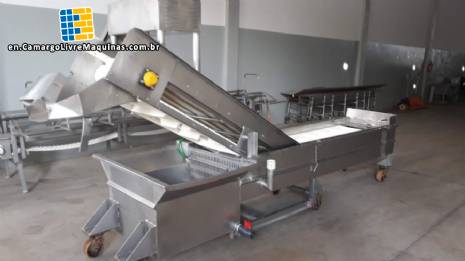
A fish glazing machine is a piece of equipment used to preserve fish (e.g., sardines, salmon, cod, tilapia) and seafood (e.g., shrimp, lobster, mussels). It works by generating a coating of thin ice or ice flakes that envelops the fish, keeping them chilled immediately after capture or during transport, preventing spoilage due to heat or bacteria.
Its main function is to preserve the quality and durability of the fish without requiring complete freezing, being widely used on fishing boats and in fish processing industries.
It can also be used for: Poultry, Shrimp, Beef, Pork, Other - Meat, Other - Fish, Amazonian Fish, Ocean Fish, Tilapia.
Types of Glaziers:
Glaziers can vary according to how they produce ice and their application. The most common types are:
- Flake Ice Glaziers:
These produce ice in thin, dry flakes.
- Ice glazing machines: These are ideal for direct application to fish, as they do not damage the food.
Used on boats, trucks, and in processing industries.
- Cube ice glaziers:
Produce ice in small cubes or pellets.
Most commonly used in fish markets or for transport in boxes.
- Continuous or automatic glaziers:
Produce ice continuously, maintaining a constant ice reserve.
They may have direct dosing systems onto the fish.
Contact or spray glaziers:
Spray frozen water onto the fish.
Maintain a thin and uniform ice layer.
Glaziers are mainly used in the fish industry, i.e., fish and seafood, because these products are extremely perishable and require rapid and uniform cooling immediately after capture or processing. |