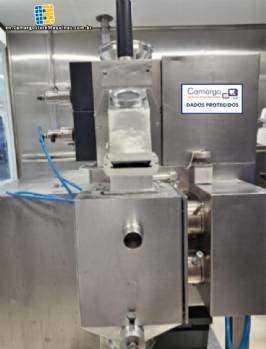
PHARMACEUTICAL DRY GRANULATION
ROLLER COMPACTOR / DRY GRANULATION / DRY COMPACTION
COMPLETE ADVANCED PHARMACEUTICAL TECHNICAL STUDY
Pharmaceutical dry granulation, internationally known as Roller Compactor, Pharmaceutical Roller Compactor, Dry Granulation, Dry Compaction, Powder Compaction, Ribbon Compaction and Dry Powder Densification, currently represents one of the most advanced processes in modern pharmaceutical engineering for high-performance solid oral dosage production.
The Pharmaceutical Granulation process through Roller Compaction has become essential in the modern manufacturing of:
Pharmaceutical tablets.
Capsules.
Hormones.
Antibiotics.
Oncology products.
HPAPI Processing.
Nutraceuticals.
Veterinary medicines.
Hygroscopic products.
High potency APIs.
Low dosage formulations.
Thermosensitive products.
The Pharmaceutical Roller Compactor is currently considered one of the most important Pharmaceutical Equipment and Pharma Machinery systems used in the global pharmaceutical industry.
Dry Granulation System technology allows the transformation of extremely fine, aerated and low-flow powders into densified granules with excellent pharmaceutic behavior, allowing stable feeding of:
Rotary tablet presses.
Automatic capsule fillers.
Continuous lines.
Continuous Manufacturing systems.
The Pharmaceutical Compaction process emerged from the industrial need to solve classical pharmaceutical powder engineering problems.
Most modern APIs present:
Low bulk density.
High cohesiveness.
High electrostatic charge.
Poor flowability.
High hygroscopicity.
Segregation tendency.
Limited compressibility.
Feeding difficulties.
Irregular behavior in tablet presses.
Without Dry Powder Densification, these powders frequently generate:
Irregular capsule filling.
Weight variation.
API segregation.
Poor content uniformity.
Sticking.
Capping.
Lamination.
Picking.
Low hardness.
High friability.
Low productivity.
For this reason, the Roller Compaction System has become one of the main pillars of modern pharmaceutical manufacturing.
The Powder Compaction process through a Roller Compactor uses controlled mechanical force to approximate pharmaceutical particles and promote structural reorganization of the material.
Through Dry Compaction, the following occurs:
Increased bulk density.
Reduced porosity.
Increased interparticle contact.
Improved flowability.
Improved compressibility.
Pharmaceutical blend stabilization.
Dust reduction.
Improved industrial repeatability.
The mechanical principle of the Pharmaceutical Roller Compactor is based on continuous compaction between two high-pressure counter-rotating rolls.
The pharmaceutical powder is continuously fed through a hopper and feed screw system, being conducted into the compaction region between the rolls.
During Ribbon Compaction, the following occurs:
Plastic deformation.
Controlled fragmentation.
Structural rearrangement.
Densification.
Pharmaceutical ribbon formation.
The ribbon subsequently passes through the integrated granulation system, transforming into uniform pharmaceutical granules technologically suitable for compression and encapsulation.
The mechanical system of a modern pharmaceutical Roller Compactor is extremely sophisticated and involves several high-precision mechanical assemblies.
Among the main mechanical mechanisms present in a Pharmaceutical Roller Compactor are:
Pharmaceutical hopper.
Feed screw system.
Force feeder system.
Compaction rolls.
Hydraulic or electromechanical system.
Gap control system.
Integrated granulator.
Granulation screens.
Containment system.
Pharmaceutical PLC.
Touchscreen HMI.
PAT systems.
Torque sensors.
Pressure sensors.
Servo-driven systems.
CIP/WIP systems.
The pharmaceutical hopper has a geometry designed to minimize:
Bridging.
Channeling.
Segregation.
Powder retention.
Many machines use:
Controlled vibration.
Internal agitators.
Anti-bridging systems.
To guarantee uniform feeding.
The feed screw is one of the most important components of the Roller Compaction System.
The feeding screw controls:
Feed density.
Ribbon stability.
Initial material pressure.
Throughput rate.
Compaction uniformity.
In advanced Pharmaceutical Granulation equipment, the feed screw system may operate with:
Servo-driven control.
Vector inverter.
Automatic torque adjustment.
Electronic synchronization.
The compaction rolls represent the mechanical core of the Roller Compactor.
The rolls may be manufactured in:
Pharmaceutical stainless steel.
Hardened steel.
Special coatings.
Chrome-plated surfaces.
High-resistance alloys.
The rolls may feature different surface geometries:
Smooth rolls.
Serrated rolls.
Textured rolls.
Segmented rolls.
The geometry selection directly influences:
Powder capture.
Densification.
Ribbon formation.
Fine generation.
Throughput.
Modern Roller Compactor systems use extremely precise adjustments of:
Hydraulic pressure.
Roll gap.
Peripheral speed.
Torque.
Synchronization.
Specific linear force.
The roll gap is one of the most important variables in Dry Granulation.
Small gap changes alter:
Ribbon density.
Ribbon thickness.
Final granulation.
Mechanical resistance of the granules.
Advanced systems use:
Automatic gap control.
Servo positioning.
Precision linear sensors.
Specific compaction pressure is generally measured in:
kN/cm.
bar.
MPa.
Depending on the pharmaceutical formulation, pressures may reach dozens of kN/cm.
The modern Pharmaceutical Roller Compactor may use:
Hydraulic system.
Electromechanical system.
Servo-driven system.
Alexanderwerk is considered one of the world's main references in highly robust hydraulic Roller Compaction systems.
The models:
WP120 Pharma.
WP150 Pharma.
WP200 Pharma.
Are globally recognized for:
High mechanical stability.
Extremely robust structure.
Heavy-duty compaction.
Excellent densification.
High industrial durability.
Compaction precision.
Alexanderwerk systems offer excellent performance in:
Hormones.
Antibiotics.
Fine chemicals.
HPAPI Processing.
Hygroscopic products.
Difficult-to-compact APIs.
L.B. Bohle is highly recognized for its advanced electromechanical Dry Granulation System technologies.
Bohle equipment stands out for:
Advanced GMP integration.
Fast cleaning.
High precision.
Excellent automation.
PAT integration.
Continuous Manufacturing.
High pharmaceutical repeatability.
The Bohle BRC line has become a reference in modern high-precision Pharmaceutical Granulation.
Gerteis is one of the global leaders in:
Pharmaceutical containment.
OEB5.
HPAPI Processing.
Hormones.
Oncology.
High potency products.
Gerteis systems feature extremely high levels of:
Containment.
Automation.
Process control.
PAT monitoring.
Occupational safety.
Fitzpatrick is extremely strong in:
Nutraceuticals.
Supplements.
American pharmaceutical industry.
High-productivity Dry Compaction.
Its Chilsonator line is one of the most traditional in the market.
The integrated granulation system of the Roller Compactor also has great pharmaceutic importance.
After Ribbon Compaction, the pharmaceutical ribbon passes through:
Granulation mill.
Oscillating system.
Cone mill.
Screening system.
The final particle size directly influences:
Dissolution.
Compressibility.
Flowability.
Filling.
Uniformity.
Modern Pharmaceutical Roller Compactor systems use extremely precise particle size control.
In many modern pharmaceutical lines, the Dry Granulation System is integrated into complete Continuous Manufacturing systems.
In these lines there is full integration between:
Blender.
Feeder.
Roller Compactor.
Tablet press.
Capsule filler.
Coating system.
Electronic inspection.
Serialization.
The Continuous Manufacturing concept revolutionized the pharmaceutical industry by enabling:
Continuous production.
Lower variation.
Higher productivity.
Full traceability.
Lower operational cost.
Greater repeatability.
PAT — Process Analytical Technology — systems monitor in real time:
Density.
Torque.
Ribbon.
Particle size.
Temperature.
Pressure.
Residual moisture.
Mass flow.
The modern Pharmaceutical Roller Compactor has become a highly automated system integrated into Industry 4.0 concepts.
Among the main APIs and pharmaceutical formulations processed through Roller Compaction are:
Metformin.
Paracetamol.
Ibuprofen.
Ciprofloxacin.
Azithromycin.
Cephalexin.
Sulfamethoxazole.
Trimethoprim.
Creatine.
Caffeine.
Vitamins.
Minerals.
Amino acids.
Testosterone.
Oxandrolone.
Progesterone.
Estradiol.
Levothyroxine.
Tamoxifen.
Anastrozole.
Letrozole.
These compounds frequently require Dry Granulation due to:
Moisture sensitivity.
Need for densification.
Poor flowability.
High potency.
Low dosage.
Segregation problems.
Encapsulation difficulty.
In the rotary tablet press, granules produced from the Roller Compactor provide:
Better die filling.
Higher production speed.
Higher hardness.
Lower friability.
Excellent repeatability.
Lower weight variation.
In the automatic capsule filler, Pharmaceutical Granulation improves:
Feeding system performance.
Product flow.
Filling stability.
Weight precision.
For this reason, Pharmaceutical Dry Compaction has become indispensable for the modern solid oral pharmaceutical industry.
The Roller Compactor has consolidated itself as one of the most advanced Pharmaceutical Equipment and Pharma Machinery systems for the production of technologically complex medicines, HPAPI Processing, Hormonal Pharmaceutical Processing and modern pharmaceutical Continuous Manufacturing. |