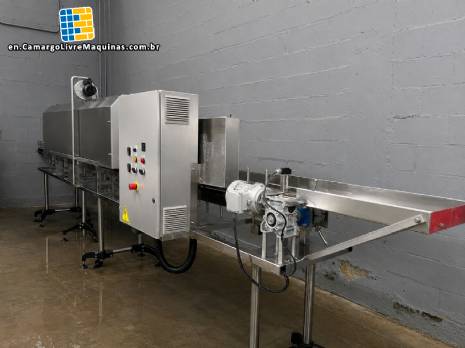
An industrial drying tunnel is an essential piece of equipment for the end of industrial bottling and processing lines (such as in beverage, dairy, food, or chemical industries). It completely removes external moisture from bottles, jars, flasks, or gallons after washing, sterilization, or cold filling processes.
An industrial drying tunnel is a continuous-flow piece of equipment designed to remove moisture, water residue, inks, varnishes, or internal moisture from products and packaging placed on a conveyor belt. The primary function of a drying tunnel is to prepare the product or packaging for the next stage of the production line, ensuring final quality and preventing losses.
Its main uses include:
- Enabling Labeling and Coding: Eliminating moisture from bottles, jars, and flasks so that labels (stickers, hot glue, or sleeves) adhere perfectly and batch/expiration date printing (inkjet) does not smudge.
- Curing and Drying of Inks and Varnishes: Used after printing, industrial painting, or enameling processes to accelerate chemical curing or solvent evaporation.
- Prevention of Contamination and Oxidation: Dries crevices in metal caps, threads, and complex surfaces after washing or pasteurization, preventing the formation of rust, fungi, or bacteria under seals.
- Sleeve Shrinkage: Some thermal tunnels also shrink heat-shrinkable plastic films around the neck or body of the product.
- Preservation of Secondary Packaging: Prevents damp products from entering cardboard boxes, which would cause softening and collapse of the boxes in storage.
The tunnels vary drastically depending on the technology used to remove moisture. The three most common models on the industrial market are:
- Air Knife Drying Tunnel (Mechanical/Blow):
Uses one or more high-pressure centrifugal blowers that force air through millimeter-sized slits (air knives). The air exits at very high speed, creating a mechanical curtain that "scrapes" water from the surface. Ideal for removing surface water from plastic or glass bottles, cans, and jars.
- Thermal Drying Tunnel (With Electric or Gas Resistors):
Combines forced air circulation with a heating system controlled by electric resistors or gas burners. Increases the internal temperature of the tunnel to accelerate water evaporation or solvent curing. For drying industrial parts, post-autoclave/pasteurization glass jars, and paint curing.
- Infrared (IR) or Ultraviolet (UV) Drying Tunnel:
Uses special electromagnetic lamps. Infrared directly heats the product (from the inside out), while UV activates the instant chemical curing of photopolymerizable inks and resins. Suitable for paint lines, graphic printing, drying electronic components, and decorated glass.
It can be used in the following industries:
- Beverage Industry (Breweries, Soft Drinks, Juices, Dairy Products): Used immediately after fillers and pasteurizers to cut the "sweat" of condensation before labeling.
- Food and Canning Industry: Essential for drying glass jars and metal lids of tomato products, palm hearts, olives, and sweets after thermal cooling.
- Cosmetics and Pharmaceutical Industry: Ensures shampoo, cream, and medicine bottles are completely dry to meet rigorous visual inspection and traceability standards (Anvisa).
- Chemical and Cleaning Products Industry: Drying gallons and bottles of cleaning products, household paints, and lubricating oils before final packaging. - Metalworking and Automotive Industry: Used after degreasing baths, chemical pickling, or paint booths for parts and auto parts.
- Packaging and Graphic Sector: For the rapid drying of varnishes on plastic reels, printed cardboard boxes, and bags. |